High Functioning Trauma?
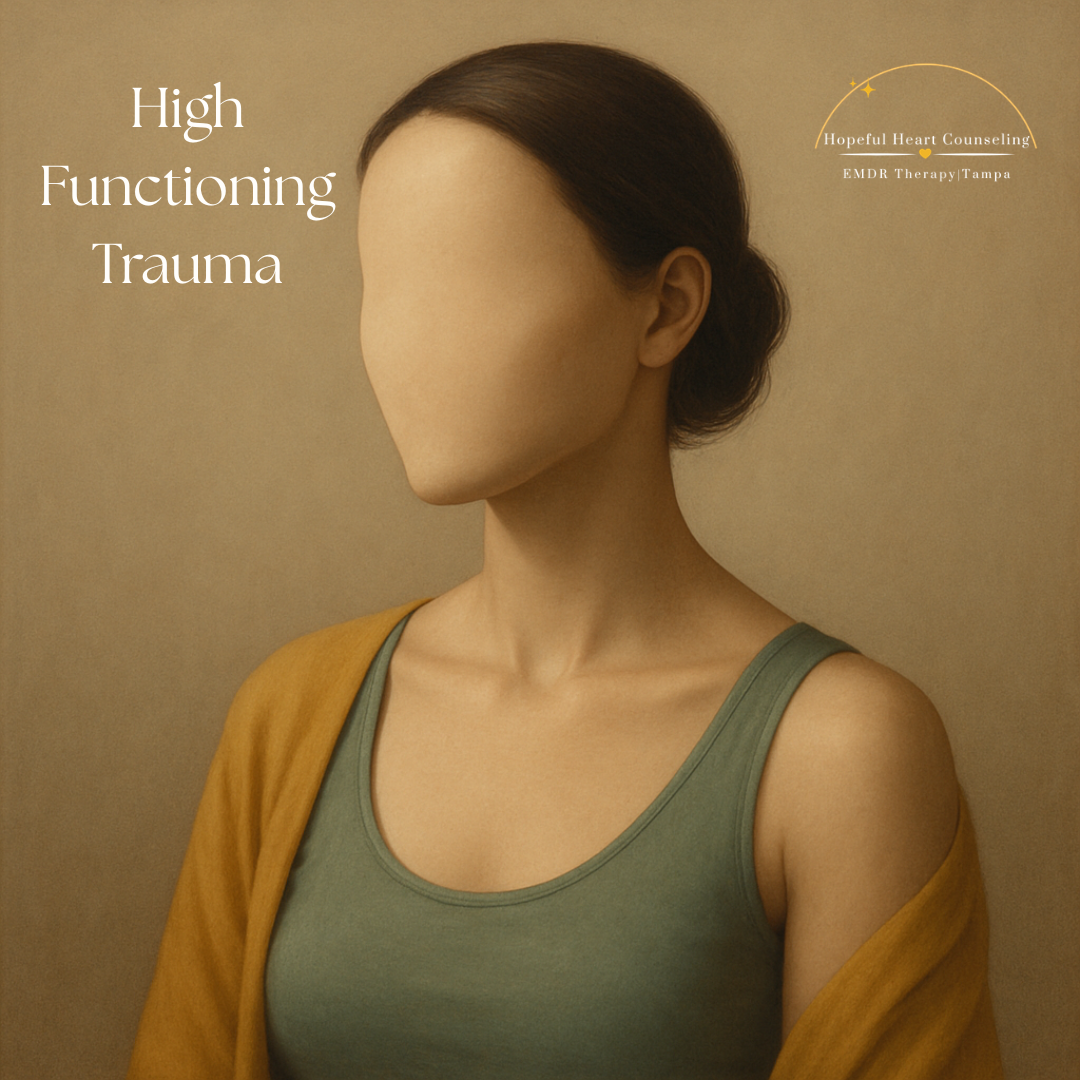
High Functioning person masking their Trauma and anxiety
A Trauma Therapist’s Perspective on High-Functioning Trauma
It Wasn’t That Bad… So Why Does It Still Affect Me?
April is often a time of growth. Things start to bloom again. People begin to feel a sense of forward movement, as they are slowly defrosting from winter.
But for many people, this season brings something else too:
Awareness.
You may find yourself thinking,
“My life looks fine… so why do I still feel anxious, overwhelmed, or stuck?”
Or even,
“Other people have had it worse. Why does this still affect me?”
If this sounds familiar, I want you to hear this clearly:
Your experiences don’t have to be extreme to be impactful.
As a specialist in trauma therapy and EMDR therapy, I have had the privilege to work with many high-functioning individuals who look “put together” on the outside—but feel very different on the inside.
This is often what we call high-functioning trauma or anxiety.
What Is High-Functioning Trauma?
High-functioning trauma doesn’t always come from one major event.
It often comes from:
Emotional neglect
Inconsistent or unpredictable relationships
High expectations or pressure to perform
Growing up feeling unseen, unheard, or unsupported
Subtle but repeated stress over time
From the outside, you may have adapted well. You may be successful, responsible, and dependable.
But internally, your nervous system may still be operating in survival mode.
In trauma therapy, we understand that trauma is not defined by the event alone—it’s defined by how your nervous system experienced it.
Why You Might Minimize Your Own Pain
One of the most common things I hear in sessions is:
“It wasn’t that bad.” “People have it worse” “I should be over this by now” “I don’t know why this is upsetting me”.
This belief often develops as a way to cope. If you learned early on to minimize or suppress your needs or emotions, minimizing your pain may feel normal.
You might:
Compare your story to others
Invalidate your own emotions
Push through discomfort without stopping to understand/process it
Feel guilty for struggling
But here’s the truth:
Minimizing your pain doesn’t heal it. It just pushes it down.
In EMDR therapy, we gently explore the experiences your brain stored as overwhelming—even if they don’t seem “big enough” on the surface.
Signs of High-Functioning Trauma
Let’s talk top signs when it comes to high-functioning trauma, this is not a complete list but they can be easy to miss because it doesn’t always look like crisis.
It often looks like:
Chronic anxiety or overthinking
Perfectionism or fear of failure
Difficulty resting or slowing down
People-pleasing and poor boundaries
Feeling emotionally disconnected or numb
Strong reactions that don’t seem to match the moment (easily triggered)
You may be managing life well—but not feeling well.
This is where many people begin seeking a and EMDR therapist or trauma therapy in Tampa.
Why You Feel Stuck (Even When You “Know Better”)
You might understand your patterns logically. You may have read the books, listened to the podcasts, and tried to think differently.
But your reactions still happen.
That’s because trauma is not stored in logic alone—it’s stored in the nervous system.
Think of your brain as a system of pathways built from experience. If your early experiences taught you to stay alert, achieve, or avoid discomfort, those pathways become automatic.
This is why you might:
Know you’re safe—but still feel anxious
Know you can say no—but still say yes
Know you can rest—but still feel guilty when you do
In trauma therapy, we don’t just work with thoughts—we work with the underlying patterns that drive them.
How EMDR Therapy Helps High-Functioning Trauma
EMDR therapy helps your brain reprocess the experiences that shaped these patterns.
Instead of just talking about your past, EMDR works with how your brain stored it.
Through bilateral stimulation and guided processing, EMDR helps:
Reduce emotional intensity tied to past experiences
Shift negative beliefs like “I’m not enough” or “I have to earn love”
Calm the nervous system
Create new, more flexible responses
Whether you’re working with a Tampa EMDR therapist or through online EMDR therapy, the goal is the same:
Helping your system learn that it no longer has to operate in survival mode.
To learn more about EMDR visit a page dedicated to explaining it more HERE
You Don’t Have to “Earn” Your Healing
Many high-functioning individuals feel like they need to justify their pain before seeking help.
But healing is not something you have to earn.
You don’t need:
A dramatic story
A breaking point
Or permission from others
If something affected you, it matters.
Working with a trauma therapist or EMDR therapist in Tampa can help you explore your experiences in a way that feels safe, structured, and supported.
Moving Toward Healing This Season
April is a season of growth—but growth doesn’t come from pushing harder.
It comes from understanding what’s underneath.
If you’re noticing patterns of anxiety, pressure, or emotional disconnection, it may not be about trying harder.
It may be about healing deeper.
As a Tampa therapist offering trauma therapy and EMDR therapy, I work with individuals who are ready to move beyond high-functioning survival and into real emotional stability.
Whether in person or through online EMDR therapy, support is available.
A Final Word
If you’ve been telling yourself, “It wasn’t that bad,” but something still doesn’t feel right—listen to that part of you.
You are not overreacting.
You are not too sensitive.
And you are not broken.
There is hope!
You are responding to experiences your nervous system is ready to process.
And healing is possible.
If you’re looking for a Tampa EMDR therapist, trauma therapy, or online EMDR therapy, you don’t have to figure it out alone.
Schedule a Free 10 minute introduction call HERE, to start moving towards healing !
Disclaimer- All content is intended for educational purposes and is not intended to supplement or substitute formal mental health support.